Congratulations! You now have access
to
a wealth of free EFT information...
Including
our Free
Stuff page!
SAVE THIS LINK FOR FUTURE REFERENCE
http://www.lifecoachingwithlindsay.com/FAQs.html
... FAQs About EFT
... FAQs About Lindsay
... FAQs from
Gary's
Manual
Click
here to download a printable version of these pages:
FAQs About
Lindsay…
For Lindsay's history with EFT and a ton of information about EFT, listen to her Podcast interviews with Ron Ball, co-author and producer of Freedom at Your Fingertips
FAQs About
EFT...
FAQs from Gary
Craig’s 79-page manual
Note: If there are any
questions not answered here, please e-mail me, and I will try to answer
them for you. If it is a frequent question, I will add it to
the answers below. I don't do consultations by e-mail,
however. So, if you have an issue that needs clearing, please set up an appointment with me or another practitioner.
Answers to FAQs about Lindsay
Q. What are your fees and
availability?
For details on Fees, special package rates and services, please visit our FEEs page
Services I offer my clients:
- Free digital recordings of your phone sessions
- Numerous free downloads
- Some surprise free tele-class
audios
- Free long distance calls for phone sessions. I'll call you (within the
Continental U.S.), thus saving
you toll charges (Outside of the U.S. you call me at the specified time)
- And much more. See the Fees Page for details and package rates
We accept

Read more about the pre-paid packages by clicking here.
To set an appointment, please contact my assistant, Katherine, at a assistant@LKcoaching.com or
at 1- 352-528-0713. If you need to talk to me about something other than appointment times the best way to
reach me is by e-mail (I’m in sessions all day, or returning
phone calls or e-mails. I return EVERY e-mail, so if you don't hear back from me in a couple of days then I didn't get your message. That happens frequently, I've discovered. So please resend it. "-)
Q. Where are you located, and what are your
hours?
A. I am
in the San Francisco Bay area, which is PST (Pacific Time), and I
take ppointments from
11 am to 5 pm. Let my assisntant know your preferences
for times (i.e. mornings, early afternoons, etc.), and
she will do her best to accommodate you. Generally, we are booked out for 4-5 weeks in advance, but I do keep a waiting list in case an earlier
time-slot opens up.
I occasionally do sessions Saturday
mornings. However, since I conduct workshops and tele-
classes on
Saturdays, and am often out of town on weekends, Saturday
appointments are rare.
Q. Do you do sessions by phone and how can EFT work by
phone?
A. Yes, I do EFT by phone; in fact, about 95% of my
clientele is now by phone and from all over the world. Actually, most accomplished
EFT practitioners work by phone as well, so the proximity to a
practitioner should not really be a factor in making your
selection. Some people,
however, prefer
in-person sessions, given a choice. It
is, however, more important to find an accomplished
practitioner with whom you resonate, than to find someone who is convenient.
EFT is actually highly effective over the
phone, and only slightly less so than a face-to-face
session.
We can’t see
the client on the phone, so we may miss subtle visual signals that
might help reading what’s going on with the client. Nor we can we
use muscle testing on the phone, which is often
helpful in
demonstrating Reversals and “asking the subconscious” questions
about what’s going on
and other situations. Otherwise, in-person and
phone sessions are pretty much the same.
When you book an appintment my assistant will send
you instructions before your session, to help our time together be more efficient. That way you'll know what to expect and what's expected of you. You'll also receive an Intake form, where you can detail your issues if you'd like.
I'll make the call to you,
(within the Continental U.S.), saving you toll charges. I record the
sessions and send you an audio so you can listen to your session
later, if you'd like.
Phone sessions are at
the same rates as office visits. Your fee must be paid in advance,
however, by credit card. You can download the
tapping points and instructions, in advance, on our Free
Stuff page.
I live and work
in the San Francisco Bay area and do sessions Monday –
Friday, 11 – 5 PST.
Let my assistant know your preferences for times
(i.e. mornings, or Tuesday only, etc.) and She'lll do her best to
accommodate you. Generally, we book appointments 2-3 weeks in
advance, but we keep a waiting list in case a sooner time-slot
opens up, which it frequently does.
If you would like to schedule a phone (or live) session with
me, e-mail my assistant, Katherine at Assistant@LKcoaching.com You
can also reach her by phone at 352-328-0713, 9am- 5pm, EST. Visit the Fees page for more information and the best arrangement
for your needs.
If want to learn more about EFT, I highly recommend
Gary’s videos, at www.emofree.com,
or attending a live workshop, www.EFTworkshops.org.
Q. How do I set an appointment with
Lindsay?
A. I have now made it easier to set up an
appointment with me. My efficient assistant, Katherine Rothgeb will
help you. Please contact her by e-mail at Assistant@LKcoaching.com (preferred)
or by phone at 888-449-3030. However, if you have a question for me first, that's not
answered in these FAQs, feel free to e-mail me .
Q. Can you help me find a
practitioner near me….?
A. Finding the right practitioner for your
needs is very important. Virtually all experienced
practitioners
work by phone and get the same results as in a live
session. So, unless you feel
very strongly about a face-to-face
visit, I highly recommend you search for the best person for your needs, rather than someone who works near you. It is far more important
to find an
accomplished practitioner with whom you resonate than to
find someone who is convenient For pre-screened practitioners,
check out my “Find a Practitioner” listings at www.NAFEH.org, and Gary Craig’s
“Find a Practitioner” listings at www.emofree.com. Additionally, I have hundreds of qualified practitioners whom I have personally trained. I list several of my favorites on the "Preferred Practitioners" page.
When searching for a
practitioner, it is a good idea to check out their website
before calling
them. Often you can find out a lot about them online. Remember, it is more important to
find an accomplished practitioner with whom you resonate, than to
find someone who is convenient logistically. Here are some things to look for:
- How long s/he has been
in practice - Look for two or more years experience as a
coach
or therapist
- How did s/he learn EFT
- Having watched the videos and having read the manual is just
not
good enough.
- What is their success
rate with EFT - It should be over 90%
- How many individual
clients have they worked with, using EFT - It should be a minimum
of 100
- What are his/her EFT
credentials – The initials EFT-CC after their name is good, but
EFT-ADV, is better. This signifies that s/he has taken and passed
a series of EFT tests. "EFT Master" is the highest credential, but there are only
a handful of Masters in the world,
so don’t limit yourself to that
criteria.
Personally, I don’t think
credentials such as a M.S., LCSW, or Ph.D. after someone’s name
is
nearly as important with EFT as their
success in using EFT. After arming yourself with information about him or her, let
your instincts tell you if you feel ‘right’ with this person. You
should have rapport (or a connection) with someone for the best
results. Trust your gut
feeling. Still uncertain? Check out some of my
favorite EFT Practitioners
Q.
Do you know someone who specializes
in…?
A. This is a
common question - and a fair one. However, any practitioner
worth their salt can deal with virtually any “tappable” issue. All of us can easily
eradicate anger, frustration, grief,
phobias, stress, anxiety,
heartache, and much more. However, for the more complex issues,
such
as rape, trauma, addictions, abuse, serious illnesses, and weight
issues, you might want
to work with a more experienced practitioner
or someone who specializes in your problem.
For instance, I have dealt with hundreds of
abuse issues, as well as addictions. However, I
prefer not to take
those cases anymore, and now refer them to my colleagues who
specialize
in these areas. If you feel that you need
a practitioner who specializes in your issue, click on the “Find a Practitioner” at Gary Craig’s website www.emofree.com. And, as long as
you are there, read the section on “Finding the Right
Practitioner” to
help you choose the best one for your
needs. Still uncertain? Check out some of my
favorite EFT Practitioners
Q. Can
you personally recommend a
practitioner?
A. I can do better than that…I can recommend several great
ones. Then, you can choose
the best one for you. Please visit the Practitioner page on our site for their contact information:
____________________________________
Answers to FAQs About EFT
Q. Why do I have to say negative
statements?
A. This is indeed a frequently asked question and a valid one.
By stating the problem (usually something negative) it brings to the
surface feelings and emotions about an event or issue, alerting the
body and our sensitive energy system where the blockage might be
(remember, the cause of all negative emotions is a blockage in the
body’s energy system). By saying the negative but true statement
while stimulating the meridians, you are sending tiny vibrations or
shock waves throughout your energy pathways. By doing so, you are
gently nudging away the blockage or disruption that causes the
negative emotion.
If you stated a positive
affirmation instead, such as, “Even though I was just robbed and
beaten, that’s OK, I feel safe and secure now” your system would
surely rebel. There would be a giant “tail ender” saying “What?! Are
you kidding me? I don’t feel secure or safe at all!” Your subconscious (or even
conscious) would have the same reaction if you left off the negative
occurrence as well and made only a positive statement.
Believe me, many have
tried this approach to no avail. It’s true that when we tell
ourselves “It’s OK, I’ll be alright” we can sometimes calm ourselves
down. But calming ourselves is not the purpose of EFT. Using EFT can
completely eliminate the negative emotion, pain or
issue.
That said, however, once the
intensity is at a lower SUDs level (3 or less) you can then switch
to a more positive choice statement. Read more about the Choice
Method on the Free
Stuff page.
Q. Do I tap on one side
or both?
A. You may have already noticed that many practitioners do
tapping differently. Since I initially learned EFT from an
Acupuncturist, who really understands the meridian system, I tap on
both sides. My belief is that you have a better chance of getting to
the blockage and dislodging it quicker by bi-lateral tapping. If you
use one hose to wash your car, you’ll still get it clean. But if a
friend joins you with another hose on the other side, you’ll get the
car cleaner faster (and probably have more fun).
That said, probably half of the practitioners out there
just use one side and get good results. I’ve tried it both ways, and
for me, double-sided tapping gets better results. I suggest you do
whatever works best for you.
Q. Is it better to use
the Karate Chop point on the side of the hand, or the Sore Spot on
the chest as the
set-up?
A. These points are virtually the same when it comes to
effective set-up statements. However, I use the sore spot on the
chest for two reasons:
- One, because the points on the chest are at
the body’s lymphatic drainage system, rubbing them consistently
helps disperse the accumulated
toxins there (which is why they are sore). This disperses them
throughout the body to be diluted and flushed
out.
- And secondly because I use the Karate
Chop point to do Reversal Neutralizations, thus distinguishing
that from the set-up statements on the chest. In reality, you can
use either points for both
objectives.
Q. Why do people use different tapping
points?
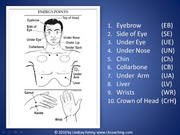
A. The body has 14 meridians throughout the body. These energy pathways come to the surface in several places throughout the body; the face, head, upper torso, spine, ankles, wrists, etc. When Gary Craig developed EFT, one of his objectives was to make it simple. You can keep EFT effective and simple by just doing the basic “shortcut” points outline in Gary’s 79 page manual; EB, OE, UE, UN, CH, CB, UA. However, by adding a few more points, the inside of the wrists, liver spot (over the liver on the right side), and the crown of the head, you are the other five meridians, therefore increasing your effectiveness rate by over 50%.
There are really no right or wrong points. We tend to do what works best for us. And for me using the 10 points (thus all 14 meridians) mentioned above brings extraordinary results. For awhile I left out the Liver Spot, just for convenience. But with the encouragement of my colleague, acupuncturist Zoe Walton, I added it back in, and I’m telling you it made a significant difference, providing much better results.
Q. How do you deal with relationship challenges using EFT?
A. Relationship challenges are just symptoms of a bigger, underlying cause. There's ALWAYS something underneath the problems, jealousy, anger, frustration, hate, guilt, etc. Often the husband reminds the wife of her controlling father, or the wife reminds the husband of his dominant, non-affectionate mother (or whatever.)
Many times someone brings their hurt from past relationships into the new one, punishing the “innocent” new partner for sins from the old partner. That is usually the cause for their friction, not the current relationship.
First I work with each person individually, neutralizing any traumas or “emotional” charges from the past. I deal with the cause for the strife that results in anger, resentment, frustration, etc. Most people see significant positive change after the first session. Once each person is "clean", I then bring them together for some couples counseling.
While each person and each couple has their individual issues or problems, the formula is pretty much the same; deal with the cause and the symptom easily dissipates. The number of total session depends on many facotrs including the severity of the issues and the willingness of the participants to do the homework between sessions. My success rate in dealing with relationship challenges, as with other issues is over 98%. But EFT is the hero, not me. :-)
Q. Can EFT be used on children, the
infirm, or pets?
A. Yes, EFT can be used on virtually anyone (including pets)
with good results. For babies, pets, the elderly, and those unable
to tap themselves you can use surrogate tapping, which is tapping on
yourself, for them. To learn more about this phenomenon search for
articles on Gary’s sitewww.emofree.com for pets, children or the
elderly. Here's an example of how
surrogate tapping is done:
When people
first find out about Animal EFT, they immediately think that it is
about tapping ON animals and ask where they should tap their
animals. It works the same as with
surrogate tapping on people. Therefore the below protocol applies whether it’s a child
an infirm person or someone in another country.
Of course animals do have a meridian system, but many
of the points are in places where animals truly do not like to be
touched, never mind tapped. The wonderful thing about Animal EFT is
that you DON'T tap on the animal directly, but you tap on
yourself to make the changes happen.
This is called Surrogate
tapping and has lots of
advantages:
- You can do it
at any time and even anywhere - you do not have to be in the same
room with the animal or person.
- You can do it
much more often than an animal would generally permit.
- You can help
wild animals, animals that don't belong to you, and animals that
you can't really touch much, such as birds and fish.
- Once you have learned the simple technique, you can
use it on any problem, on any animal and you don't have to know
anything at all about their various meridian systems or
points.
How does
Surrogate EFT work?
When you focus
your attention on an animal, you connect your energy system with
theirs. When you
keep the focus of your attention on a specific aspect of that energy
system (a problem, disease, behavior, state of mind and so on) and
you change YOUR system by tapping on the points, YOU ARE ALSO
CHANGING THEIRS through the connection.
This was originally discovered when a lady, distraught
because she was sitting by the side of her premature baby's
incubator and unable to touch him, treated herself for the baby's
problems and the baby responded by breathing more easily and slower,
and finding from somewhere the will to live and to fight on more
strongly than before.
Since then, thousands of people all over the world
have been absolutely astonished to find that by tapping on
themselves whilst holding another living being's problems in their
mind, they can make changes without touching them or even being in
the same room.
I don't expect you to believe this right away. I
didn't believe it either when I first heard about it. But I tell
you, when you neighbor's dog 100 yards away stops barking after an
hour just because you have tapped a round of EFT on yourself, a
shiver goes down your spine and you KNOW you made that happen as if
by magic, it is a real convincer
experience.
So next, here is the Animal EFT protocol for you to
try out on any animal you choose.
The Surrogate
EFT Protocol
1. Focus Your Intention
Think about the
animal and what specifically you would like to release, relax,
soothe or change.
2. Make A Statement Of
Intent
Find a phrase
or a sentence that describes the problem succinctly and clearly to
you.
You can say,
"Sidney has this terrible allergy." or "Sam never stops barking."
or, "This brown horse is distressed." if you don't know the animals'
name. This is the main part of directing your attention to the
problem.
3. The Setup
statement
We surround the statement of intent with the words,
"Even though (Sam) (is hyperactive), I deeply and profoundly love
and accept (Sam)." It helps bring you closer to the animal for
deeper changes and handles permission issues as well as having
positive benefits for YOUR system.
4. The Full Opening Set-Up
Place your flat hand on your chest, either left or
right, just above your heart. Wait until you can feel the warmth of
your hand through your clothes, rub the hand round in a small circle
and say the opening statement which is the statement of intent
inside the blessing:
"Even though (insert name or description) insert
statement of problem), I deeply and profoundly love and accept (name
or description)."
Repeat this opening statement three times in all,
continuously rubbing the chest area just below the collar bone known
as the Sore Spot.
5. Tapping All
The Points We now use a
shortened version of the opening statement which is called the
Reminder phrase and tap lightly with three fingers, about seven
times, on the following spots (both sides is best) while saying the
reminder statement of “this------(whatever the issue
is):
Start Of The Eyebrow - Where the
bone behind your eyebrow turns into the
bridge of your
nose.
Corner Of The
Eye - On the bone
in the corner of your eye.
Under The
Eye - On the bone
just below your eye, in line with your pupil if you look straight
ahead.
Under The
Nose - Between you nose and
your upper lip
Under The
Mouth - In the
indentation between your chin and your lower lip
Collarbone - In the angle
formed by your collarbone and the breastbone
Under
Arm - in line with
a man's nipples on the side of the body
Liver Point - about 2-3 inches under the breast or nipple
Wrists - bump the inside of your wrists together at the crease between the hand and arm
Top of the Head - at the crown of the head
Karate Chop
Point - on the side
of your hand, roughly in line with your life line.
When you're all the way through, take a deep breath in
and out. You can repeat the treatment with a different statement -
often something comes to your mind as you do this. Different
statements create different changes, so experiment with many
different forms of wording and ways of saying something until you
feel comfortable.
Repeat this process until the issue dissipates. Surrogate tapping
for complex issues should be administered by an experienced
practitioner.
Q. How long do I have to tap to get
results?
A. The short answer is: Until you get the result you want. I want to expand on that a
bit though. Normally you can resolve an issue in 3-4 rounds, which
only takes a few minutes. Simple issues are particularly quick and
easy to deal with. Sometimes, however, it may take 5-6 rounds, or
even 10-12 to resolve a difficult issue. You may need to go through
several “doors”, look at many different aspects, and dig for the
core issue, to get the optimal end result of complete resolution.
That takes time. But, that could be an hour, or two at the most, to
completely resolve a painful, lifelong issue.
Traditional therapy could take months or years to resolve the
same problem. We often
get spoiled with “one-minute-miracles” getting impatient when
something is taking too long. But we must keep it in perspective and
realize that even the most difficult or complex cases can be
resolved to completion in a fraction of the time any other
therapy might hope to offer. Patience and Persistence is the key to successfully resolving
challenges issues. Time should not be a factor.
I want to point out that it’s also important to
make sure an issue is completely resolved before leaving it. Some
people say “Gee, I feel better now” and stop at that. Later when
they feel a negative charge again about the same issue, they will
think that EFT didn’t work. I hate it when that happens! If you
truly get all of the aspects resolved and get an issue to a zero on
the SUDs scale, then it’s likely gone for good.
That’s not to say that at some point an aspect that was
missed might not pop up for you. But resolving that should be very
easy, since the bigger components have already been collapsed. So, stay with it until
you’re sure an issue is completely resolved. Test yourself by trying
to get upset about it again. If you just can’t find a charge, then
you’re likely done. That’s how long it takes.
Q. Why is it important to know my SUDs
level and what does SUDs stand
for?
A. SUDs
stands for Subjective Units of Distress (the ‘s’ at the end is
superfluous, but is commonly used anyway). It’s important to know
your intensity level so you’ll know where you are and where you need
to go. If you simply say, “I’m really upset” that doesn’t
give you much information. If you can put a number to it, say a 9,
for instance, even if it’s subjective, you at least you have a
guesstimate of a starting point. Then as you tap and get in touch
with your decreasing SUDs level on subsequent rounds, you’ll know
you’re making progress. You’ll also have a handle on how far you
still need to go to completely resolve an
issue.
Conversely,
if your number hasn't’t changed after a couple of rounds, you know
you’re missing something, and will need to make some changes (see
the “9 Stumbling Blocks of EFT” to give you direction). Likewise, if
you get down to a 2, you know you’re close, but not quite finished.
You want to keep going until you can say for certain that you’re at
a zero.
It’s important
to remember that the objective of EFT isn't’t just to “feel better”
(although that’s certainly nice). The ultimate goal is to realize a
complete cessation of a negative emotion or issue. So don’t stop
just because you start to “feel better”. Keep tapping until you’re
feeling great and the issue has been completely put to
rest. If you truly get to a zero
on the event, issue, pain or whatever, it’s unlikely it will
return. To make sure
that you’ve really neutralized problem, test yourself by trying to
get upset. Revisit the issue, even the formally painful aspects and
see if the intensity rises at all. If it does, you still have some
work left to do.
If
the event, pain or issue seems ‘fuzzy’, hard to remember or
difficult to grasp, and there’s no “charge” left, then you are
likely done. When my
clients get to a zero, I ask them how they know that. Often it’s the cessation of
a physical manifestation, such as tightness in the shoulders or
neck, or an upset stomach. Or, they might feel profound relaxation,
feel lighter and experience renewed energy or peace of mind. I love using the SUDs rating
and check it several times (usually after every 2 rounds of
tapping) in the course of eliminating an
issue.
Q. What if I don't know my intensity level?
A. It’s not always easy to figure out, on a scale of 1 to 10,
how much your shoulder hurts, or how angry you are at your
brother-in-law, or how afraid of spiders you are. At best, it’s a
subjective guess. While many people come up with their SUDs level
right away, many others struggle with this little aspect of EFT. I
ask clients to guess what their number would be. Try saying this
sentence out loud rather fast, without pausing at the end. Just say
what comes to you. “Even though I don’t know what my intensity level
is, if I had to guess I’d say it was at a…..”.
This simple little trick bypasses the conscious
mind and allows the subconscious to provide the answer. Good practitioners generally
know where someone stands as they talk about their issues. So, if a
client’s number is far off from the estimate of the practitioner, he
or she would have occasion to question the client’s answer. When
working with yourself, however, you can only guess and do your
best. Chances are, if you don’t analyze it too much and just go
with your gut feeling, you’ll be just fine. As stated in the above
question, it's important to get the SUDs rating so you’ll know
where you are and where you need to go.
Q. How do I deal with an intangible issue or get a SUDs rating on it? What if I have a problem
like procrastination, or lack confidence around new employees, or
want to lose 30 pounds, or I'm just stuck and can't get going? How
do I measure or test issues like that?
A. To deal with intangible or hard-to-measure issues,
I use what I call the Ultimate Truth
Statement. Here’s how you can use this interesting and
effective tool: Develop
a sentence that would represent the most positive outcome you
would like to achieve. For instance, if you have a problem with
procrastination, use an Ultimate Truth Statement of “I always
complete tasks in a timely manner, never putting things off, and
always keep commitments with myself and others.”
Please download and read my artilce about how to use this powerful process Ultimate Truth
Statements
Q.
Does EFT work for…?
(whatever)
A. One of the most common questions EFT Practitioners hear is, “Can EFT
help with…. PTSD, diabetes, hepatitis, multiple sclerosis, pimples,
etc?” To which we
almost always respond “Probably! Try it on everything!” A
more thorough, and accurate, answer, however, would be: “Many others
have experienced great results with your issue, so it is highly
likely that you will get resolution too.” It’s safe to say
that EFT has been tried on just about every issue, problem or
physical ailment you can image.
We
know EFT can bring miraculous results to virtually
anything…especially in the hands of an accomplished
practitioner. And since
EFT has never been known to harm anyone, it’s painless, and it works
when nothing else has, go ahead and try it on your issue. I’ve used it on everything
from corns to cancer, and from hiccups to hypertension.
In
experienced hands, EFT delivers significant relief over 90% of the
time (the medical profession would love to have those results). Many
cases, however, especially if complex, require more than just
applying the basic sequence. So, if you’ve already tried EFT and aren't’t getting the
results you want, it’s unlikely any shortcoming of EFT, but rather
that you’re missing some important element. Virtually all complex issues
should be dealt with by a competent EFT
Practitioner.
There
is an art to EFT that goes far beyond what you can learn in
the 79-page manual or even by watching all of Gary’s wonderful
videos that only comes with experience and practice. For instance, there are
several obstacles that can impede EFT’s progress. I suggest you read
my article “The 9 Stumbling Blocks of EFT” which you can find at on
this site on Free
Stuff page. Or enter the above title in the
search bar at Gary’s site www.emofree.com.
Q. What’s the best way to learn
EFT?
A.
There's so much to EFT that you should take several
routes. EFT
is elegant in its simplicity, however, there is SO much more to
it than meets the eye. EFT is effective for hundreds of simple
issues and can be self-applied, however, for more complex issues you
should see an experienced practitioner.
- Start the learning process by downloading Gary’s free
79-page manual at www.emofree.com. While there, consider purchasing
Gary’s fabulous video programs on
EFT.
- One of the best ways to learn EFT is by doing an approved EFT workshop. Level 1 is for beginners, even those who have
watch the videos and read the manual. Move up to Level 2 after
doing 1 and when you have more experience with EFT. Take Level 3
when you ready to take your knowledge to the next level. While
Level 3 is not exclusively for aspiring practitioners, it is often
the serious student who will take that course. Go to the next
question to see where you can find
one.
- We offer the Ultimate Practitioners Workshop for qualified students. Read about it at the above link
- Read the book "Freedom
at your Fingertips" by 20 World Class EFT practitioners
(including Lindsay).
- Another way to learn EFT is by seeing a practitioner for
your own issues and learn as you go.
- You can also learn a lot about EFT on our EFT pages . There is a wealth of
information there, including case histories, testimonials,
workshops, teleclasses, and audio files. And by all means, check
out our "Free
Stuff" page. There you’ll find many other
resources for learning EFT.
- If you can't attend a workshop live, try one of our Tele-Classes, and order my new "Ultimate Level 1
Workbook".
Q. Where can I find a
workshop?
One of the best ways to learn EFT is by
doing an approved EFT workshop (start with Level 1 and then move up
to 2 and 3). Visit my workshop site at or, for a workshop in your area, check out Gary’s site www.emofree.com and go to the “Learn EFT”
section.
Q. I’ve tried EFT, but it’s just not working
for ME. What now?
A. When people try EFT for ‘old’ problems, or complex
issues, and aren't’t getting the results they want, they may
think EFT just isn't’t working for ‘them’. Others think that maybe the
testimonials they’ve heard aren't’t real. Actually, neither is
true.
As wonderful as EFT is,
there are several impediments that can get in the way of its
success. For one, beginners should only try using EFT on “simple” issues, leaving more complex problems to experienced practitioners.
Please read my article about
the 9 Stumbling Blocks of EFT. You can download it on
the Free Stuff page. You can also purchase an
audio series there about the same topic. If, after reading the
article, you are still having problems, you may need assistance. The
article explains why that is true. Sometimes, even we experienced
practitioners need the eyes, ears and intuition of others to get to
the heart of the matter -especially for complex issues.
Q. What’s the
difference between Simple and Complex
issues?
A. First let me
“broadly” define “Simple” issues. There are no hard and fast rules,
but typically simple issues are problems that are
usually:
- Single faceted, like
the hiccups, or your boss embarrassed you at the sales meeting, or
you’re disappointed that you didn't’t get the promotion you wanted,
or you’re stressed after a tough day at work.
- Recent, as opposed to
something that happened years ago, or has been going on for a long
time.
- Not chronic; that is
it’s not a persistent problem like chronic
pain, anger or grief
- A simple pain or injury, as opposed to a complex medical issue or a
serious illness
- Fear or simple phobias
- Emotions like stress,
frustration, anger, embarrassment, cravings,
etc.
- Ones you can generally
work on and resolved yourself, with some basic knowledge of
EFT
I believe there are Two Tiers of
complex issues, which almost always involve more than one
aspect. Tier one
issues include things like grief, chronic pain, “minor” traumas,
allergies, some abuse issues, weight issues, food addictions,
stuttering, and most non life-threatening illnesses. Many of the examples used in
my “9 Stumbling Blocks” article (available on the Free
Stuff page) are examples of Tier 1 complex
issues. Some of
these you can work on yourself. If you’re not getting a resolution,
you should contact a
practitioner.
The second, or more-difficult-to-work-with, Tier 2, includes child
abuse, sexual or ritual abuse, traumatic or life-altering accidents
or deaths, severe and sustained physical or emotional abuse, drug
addictions, morbid obesity, and so on. Tier two complex issues are
usually highly charged emotionally, or often, a result of very
traumatic occurrences. Also included in these more difficult cases would be
psychological problems, such as bi-polar, schizophrenia, multiple
personalities, serious illnesses and so on.
Here’s what’s important to remember: Most simple issues can be
handled by anyone, including yourself. Complex issues, especially
Tier 2, need to be dealt with by an experienced practitioner. Nonetheless, in case you’re
curious, or just want to know more about complex issues read my
article “EFT issues, Simple or Complex?” on the Free
Stuff page (the
article is mostly for other practitioners, but you’re welcome to
read it too) But again,
please consult a qualified practitioner for the tough
stuff.
Q. What words and
phrases do I use?
A. This is a simple, yet complex question and one of the most
frequently asked. The easy answer is this simple formula: Add
an acceptance affirmation to your problem, such as, “Even though I
have this __________(fill in your issue), I deeply and completely
accept myself.” However, there is a bit more to it than that. What’s important to remember
is that you can’t do it “wrong”, but some phrases are more effective
than others. Try it
different ways, until you get the result you want.
To learn about doing set-up phrases,
and what’s important about them, read my article on the “9 Stumbling Blocks of
EFT”, which is downloadable at my Free
Stuff page. Being specific, finding the core issue, and getting rid of
Reversals are imperative to successful EFTing.
Here are some
examples of set-up statements. Remember, being specific is
important.
"Even though I have this fear of speaking to groups over
5, I deeply and completely accept
myself."
“Even though a part of me doesn't’t want to forgive my
mother for hurting my feelings at Christmas, I accept who I am
without judgment.”
"Even
though I have this sinus headache above my eyes, I deeply love and
accept who I am."
"I
deeply and completely accept myself, even though I have anger
towards my father for yelling at me last night."
"Even
though I have this stiffness on the right side of my neck, I
completely accept myself and love my body."
"I
deeply accept myself unconditionally, even though I have a killer
craving for chocolate right now."
"Even
though I have this fear of snakes, I love and accept myself
anyway."
"I deeply and profoundly accept
myself, even though I’m really sad over my breakup with
________.”
Q. How many sessions will it take to deal
with my issue?
A. There isn't an easy, pat answer to this question. There are
so many variables among people and issues that it could take 1
session or 5. Some might even be more than that. Complex
issues, weight issues, abuse, trauma, and many others often take
several sessions. Often I'm done with someone in 30 minutes,
depending on the circumstances. I find that we can often deal with
1-3 issues per session. However, many people have multiple
issues making it hard to tell without really getting into the
matter.
One lady, for
instance called me because she was 'stuck' at work and couldn't seem
to get the recognition she wanted. That seemed, on the surface like
a relatively easy matter to be dispensed with quickly. As it turned out,
however, there was a considerable physical trauma in her life that
had to be dealt with, the suicide of a family member, an eating
disorder and much more. And while "Ann" didn't think any of those
things contributed to her problems at work, they were actually
critical to her success (or lack thereof).
So the answer to
this question is "It depends". However, long it takes will be
considerably less than tradition therapies of any kind, and likely
much more effective.
Q. Why do
I sometimes get sad, depressed or agitated after a
session?
A. It’s
not uncommon for people to experience a negative reaction after (or
during) an EFT session, especially if you are tapping for
yourself. Feelings such
as anger, anxiety, uneasiness, sadness or even temporary worsening
of the issue(s) might emerge. They are not side effects of EFT, nor
is there anything wrong with you. There are several possible
causes for these odd-feeling emotions you may experience during or
after tapping. Here are some of them:
1) You
may be regretting previous choices you've made in life (or things
that have happened to you.) Or you may be saddened when reminded of the “opportunities
wasted” in your life due to your issue. These regrets or feelings
are often suppressed until EFT is introduced and things become
stirred up. It’s natural to think, then, that EFT has caused these
“new” feelings, when in fact EFT has simply reminded you of
something you have suppressed that needs to be dealt with. Remember EFT’s Discovery
Statement is “The cause of ALL negative emotions is a disruption in
the body’s energy system”. Left untreated, those energy blockages (manifested as
negative emotions) can lead to a plethora of physical
ailments.
2) While in the process of clearing major traumas or issues with
EFT some people become anxious or fearful sensing the possibility of
living life with a different set of rules. Being free from past
baggage might mean risking rejection rather than living inside a
“bubble of protection” provided by the previous challenges. For
instance, those who have been victimized may have often blamed
others for their crummy life or bad choices. Once EFT starts lifting
the curtain of pain, blame, shame and resentment, they realize that
they don’t really know how to live a life of accountability. They might feel like a
fish-out-of-water as they begin to see life from a completely
different perspective.
We often have two parts of us that
battle for dominance. The old, familiar part feels out-of-sorts or
fearful because it doesn't’t know how to conduct itself in a different
paradigm…with a new identity. Being accountable, responsible and optimistic can be
frightening if you’ve never or seldom experienced those
sensations. Yet the
“other” part of you may yearn for that freedom and peace of
mind. It could be this
dichotomy that causes the discomfort during or after
tapping.
3) Another cause for anxiety or fear during
or after tapping is that there may be a payoff for keeping your
issues. Some people are
financially compensated for a disability, while others may get
emotional support with attention, sympathy or special favors as a
result of their issues. When these payoffs are threatened by using
EFT, a part of you may be reluctant to change or to give up these
payoffs. Similarly the grief over losing a loved one, the pain from
being traumatized or victimized, or the memory of a horrific
incident can grow into an “excuse” for your life not working. The
realization that you may no longer have this excuse might be
overwhelming.
Please
don’t misunderstand. I’m not saying that you would consciously choose to be incapacitated, or stay ill, or
continue to live in pain or to remain traumatized. However, a part of you may
be very protective of these secondary benefits and therefore be
reluctant to let them go, triggering
the anger, sadness or anxiety after an EFT session. (For more
information on this read my Reversals article here on Gary’s site,
or on the Free
Stuff page of this website.
4) A
part of you may be sad (or even sick to your stomach) when you
strive to leave the old identity behind. Sometimes there's a
reluctance to do say goodbye for reasons that vary among different
people. Just as people stay in bad marriages or keep a clunky care
because it's at least familiar, we sometimes want to stay with what
we perceive as a safe place, habit or personality. To change what's become so familiar is
disconcerting to some, while exhilarating and uplifting for
others.
5) The
most likely cause,
however, for feeling unsettled after doing EFT is that you simply
haven’t reached the core issue yet. Sometimes getting close to a
painful memory causes us to back off. Perhaps you’ve peeled the
first layer of the onion and the layer underneath is “stinging your
eyes.” You may be only
partially into your issues and are stirring things up before
completion. My friend and workshop
co-facilitator, Zoe Walton says this about core
issues:
“If you don’t know what your Core
Issue is when you start a session and you proceed to tap on the
various aspects you do know about, you may end a session without
finding the actual cause of your problem -- the Core Issue. For
example, you may be tapping on an uncomfortable emotion or body
sensation that is happening at the moment, such as rage or tightness
in the throat. But you would only be addressing a symptom,
not the main cause. Underneath that rage, a deeper Core Issue, such
as “he never really loved me” or “my mother abandoned me” still
needs to be addressed for full resolution.
When the Core Issue is not dealt
with, it is like chopping off the green weeds in a lawn but never
getting to their roots. Also there might be many Core Issues around
a particular issue and one session only dealt with one of the Core
Issues, leaving more work to do. Confusion,
“foggy-headedness”, anxiety, headaches, anger, or sadness often
means that you’re simply not done with the problem or haven’t found
the all-important core issue.
It is often hard to discover Core
Issues on your own. It is sometimes hard for us to see our own
problems clearly, just as a dentist would have a hard time giving
himself (or herself) a root canal. That is where a good practitioner
can help.”
6) There’s
still another possibility for post-tapping problems. It’s highly
likely that you are working on issues far too complex for you to
handle alone. EFT is
magical and extremely effective in the right hands. Beginners should generally
stay with simple, rather than complex issues. Serious trauma issues,
abuse, depression and other complex topics usually need the
perspective of an accomplished practitioner. Sometimes people get
frustrated that EFT isn't’t working for them, when in fact it’s just
that they’re not experienced enough to deal with their own issues.
Look
at it this way -- if you experience negative stirrings after a
session it’s actually a good sign that EFT is in fact starting
to work. Your body or
emotions are reacting because you’ve scratched the surface of
something that needs to be dealt
with.
So
if you get stuck, don’t stop! Find some help to work through your issues. Check Gary’s
practitioner listings on this site for a competent practitioner to
assist you and don’t give up on yourself or on EFT!
Q. How
can I learn enough about EFT to become a practitioner?
A. Although
even beginner can generate impressive results with EFT, the more you
learn and practice the more competent you will become. EFT is
capable of far more than what you can learn in Gary’s 79-page
manual, but that’s an excellent place to start and it’s free. Here are some other options:
- Order
Gary’s EFT videos on EFT at www.emofree.com Click on the “Learn EFT button, for
a list of great video products. After learning the basic
videos, my favorites were the two “Specialty Series” and “Steps to
becoming the Ultimate Therapist”. If you haven’t already ordered
Gary’s videos you’ll be pleasantly surprised to learn you get
about 5-6 DVDs with each order. And he offers 40% off with
purchases over $100. It’s an amazing bargain!
- Take
Approved Levels 1-3 workshops where you can actually practice EFT,
work on your own issues, and get your questions answered. You’ll
learn even more in a live workshop than in the initial videos. To
really learn how to do EFT effectively, it’s great to do both.
Check Lindsay’s EFT Approved workshops at www.EFTworkshops.org or the Approved
workshops at Gary’s site www.emofree.com Ask others
for referrals to workshops that are highly
recommended.
- See
a practitioner in person, or by phone. Find one at either www.emofree.com or at my sister website www.NationalAllianceforEmotionalHealth.com You can also obtain a lot
of information there about EFT including testimonials, case
histories, and free downloads.
- Practice, Practice, Practice. There’s nothing like
getting out there in the trenches and doing as many cases as you
can. Just remember to stay with SIMPLE issues until you
know what you’re doing. Practice on friends, relatives, and pets
until you gain skill and confidence.
Contact Lindsay about
her “Becoming a Practitioner” program
The following are FAQs as published in Gary’s fabulous
79-page manual. If you haven’t already done so, I recommend that you
read it to get you started in EFT. Download your free copy at www.emofree.com . Gary pretty
much says it all below, but I have added some of my own comments in
italics
Q. How is EFT different
from a "quick fix?"
A. The label "quick fix" carries with it a negative connotation
and is often used to label the questionable healing techniques of
hucksters and cheats. The term goes hand in hand with the term "con
man" and, when used, often brings about thoughts of suspicion and
caution. EFT offers rapid relief from numerous emotional and
physical ailments without meriting the negative label "quick
fix."
This is obvious to any
observer of the case histories in this course and is even more
obvious to those students who have experienced the results first
hand. I use the term rapid relief instead of "quick fix" to put
across the same idea but without the negative
connotation.
Now here's an important
note: Throughout history healing techniques of various kinds have
usually been low and inefficient until someone finds the true remedy
for the ailment. When the true remedy is found, everything changes
and the old methods become relics of the past.
Polio is a case in
point. Until the Salk vaccine was discovered, Poliomyelitis was
considered incurable and all manners of medications and therapies
(including the Iron Lung) were employed to help the sufferers. They
didn't do much, of course. They helped ease some of the discomfort
and limited some of the long term damage caused by the disease. But
that was about it.
And then came the Salk
vaccine. It did away with all the antiquated, inefficient attempts
at curing Polio and replaced them with a true remedy. It was,
indeed, a "quick fix" without the negative
connotation.
The eradication of Polio
is only one example where inefficient methods give away to true
remedies. Penicillin,
for instance, has been another "quick fix" miracle drug that has
provided instant cures for illnesses ranging from respiratory
diseases to gonorrhea.
The examples go on and
on, of course, but the point is that these procedures are replacing
all the inefficient techniques used in behalf of emotional health.
The fact that they give rapid relief to seemingly difficult
emotional problems is impressive evidence that they represent the
true remedy. If they took forever to do very little then they should
simply take their place among the other ho hum techniques of the
past. But they don't. They hit the bull’s eye and perform as a true
remedy should…quickly, easily,
permanently.
Q. Does it last?
A. This question is usually a companion to the above "quick fix"
question. After all, the "logic" goes, any problem that can be
relieved that fast must be temporary. Lasting results, at least in
the minds of most people, must take time to
produce.
Not so. EFT's results
are usually permanent. The case histories in this course are filled
with people who have had lasting results...even though the problem
was relieved in moments. This is still more evidence that EFT is
addressing the true cause of the problem. Otherwise, the remedy
would not be so long lasting.
Please remember,
however, that EFT doesn't do everything for everyone. Some problems
seem to reappear and that is usually caused by different aspects of
the original problem showing up at a later time. The experienced
student of EFT will recognize this and simply reapply The Basic
Recipe for this new aspect.
My experience is
similar to Gary’s in that if a problem crops back up a related
aspect might have been missed originally. Also, if an issue wasn't’
taken all the way to a zero, you might see a reoccurrence. That’s why it’s important
to get every issue to a zero. And you can test that with probing
questions or actually trying to get yourself upset again. If the
intensity goes up, you’ll know there’s still more work to do…often
on a different aspect. For more information on that read my “9
Stumbling Blocks of EFT”on the Free Stuff page.
LK
The experienced student
will also break the problem down into specific events and apply EFT
to those underlying causes. In time, after all aspects and specific
events have been addressed, the problem usually goes away completely
and does not return.
Q. How does EFT handle
emotional problems that are very intense and/or have been with a
person for a very long time?
A. The same way it handles every other emotional problem. To
EFT, the intensity of a problem or how long it has been around is
immaterial. The cause is always a disrupted energy system and using
The Basic Recipe to balance it gives relief...regardless of its
severity.
“Old” issues,
however may be ingrained in the body’s memory or subconsciously
the body wants to hang on to the problem. This is what I call a
Polarity Reversal (or psychological reversal). If a reversal is in
place, and it often is with old or serious issues, you’ll need to
neutralize it before EFT will work. To learn how to do that read
my article on Reversals click on the Free Stuff page to
download it.
LK
This question usually
comes about because of the belief that intense and/or long resident problems are more "deeply ingrained" than other
problems. Therefore it should take more effort to relieve them. This
seems very logical when viewed through conventional approaches
because conventional approaches don't directly address the true
cause.
Conventional approaches
tend to take aim at one's memories or other mental processes and
ignore the energy system (where the true cause lies). When slow
progress is being made it is convenient to blame the problem because
it is presumed to be "deeply ingrained" or otherwise difficult to
deal with. In this manner, conventional approaches can...and
do...explain away ineffective
results.
When EFT requires
persistence it is NOT because of the intensity or resident length of
a problem. It is usually because of a problem's complexity.
Complexity, to EFT, means the existence of several aspects to a
problem each of which must be relieved before total relief is felt.
The notion of aspects is covered repeatedly in this manual, the
videos and the audios.
Note: The above comments may or may not apply to serious mental
illness. The application of EFT to such
disorders has proven helpful but it should only be applied by a
professional skilled in this
area.
Q. How does EFT deal
with one's need to understand their problem?
A. This is one of the most astonishing features about EFT. A
shift in a person's understanding of their problem happens
simultaneously with the relief. After EFT, people talk about their
problem differently. They put it in a healthy perspective. The
typical rape victim, for example, no longer carries a deep fear and
distrust of men. Rather, she considers her assailant as having the
problem and needing help.
People who use EFT for relief from guilt no
longer take blame for whatever event gave rise to the guilt. Anger
turns to objectivity. Grief turns to a healthy, more peaceful
perspective about the death of a loved one. Notice how you and
others respond to your former problem and you will see what I mean.
Your understanding shifts right along with the relief. Here's a
final note on how powerfully EFT shifts understanding. In the
hundreds and hundreds of people Adrienne and I have helped with EFT
not one of them...ever...has made any request to better understand
their problem. Why would they? There was no need.
Furthermore, people don’t have to
‘believe’ in EFT in order for it to work. In fact, some of my
biggest successes, and now advocates, are those who were the
biggest skeptics in the beginning.
LK
Q. How does EFT deal
with stress and
anxiety?
A. In EFT, stress and anxiety have the same cause as all other
negative emotions...a disruption in the body's energy system.
Accordingly, they are addressed with The Basic Recipe the same as
any other emotional issue. Anxiety has a specific meaning in
clinical psychology. It refers to an intense fear or dread lacking
an unambiguous cause or a specific threat. In EFT, however, we give
it a much broader definition to include that general state of
uneasiness which is more commonly known as anxiety. Under that
definition stress and anxiety fall into the same
category.
Stress and anxiety tend
to be ongoing problems because the circumstances that create them
are ongoing. An abusive family situation or a stressful job
environment are but two of a long list of possibilities. EFT does
not do away with the circumstances, of course, but it is an
important aid to reducing your anxious responses. In most cases, EFT
will need to be used persistently (most likely daily) because the
stressful circumstances tend to show up every day.
After a while, you
should notice that your responses to difficult events is much
calmer. Things just don't get to you like they used to. You smile
more. Your health improves and life seems
easier.
Q. How does EFT help
with sports performance?
A. Ask any accomplished athlete and they will tell you
emphatically that their mental set is critical to their performance.
The difference between good days and bad days for the athlete is
almost always due to emotional causes. Barring sickness, the athlete
always brings the same highly skilled body into the field of battle.
The only thing that changes is the effect that emotions have on the
body.
Everyone, including
athletes, has their share of negative thoughts and self doubt. By
now you are quite familiar with the fact that those negative states
of mind disrupt the body's energy system and cause negative
emotions. These negative emotions show up in the body in a variety
of ways (pounding heart, tears, sweat, etc.) and this includes some
tension in the muscles.
In athletics, timing is
everything and even the slightest tension in the muscles affects it.
Hitting a baseball, tennis ball or golf ball requires perfect timing
and being off by just 1/8 of an inch is the difference between
hitting a home run and flying out…or...hitting a killer serve or one
that hits the net…or...making or missing a putt. And so it
goes.
Athletes are well aware
of this problem and many hire sports psychologists to help them in
this regard. Any
negative emotion...even the mild ones and the subconscious
ones...can be critical to an athlete's
performance.
EFT provides a
remarkably effective solution to this problem. The purpose of The
Basic Recipe is to neutralize negative emotions and their effects.
One of the most common responses to it is that people feel relaxed
which, by the way, is another way of saying that the tension has
left their muscles. This is ideal for the athlete because it
neutralizes any unnecessary emotional tension in the muscles without
affecting the rest of their athletic ability. It allows their
potential to flow through without being hindered by any resistance
in the muscles.
Q. Why does EFT give
surprisingly good relief from physical problems?
A. This is easy to understand in light of the emerging attitudes
toward the existence of the mind-body connection. EFT provides
striking evidence of this connection. What more obvious proof could
one want than to watch changes in both mind and body occur as a
result of tapping on the body's energy
system?
But the evidence goes
even deeper than this. Applying EFT for emotional issues often
brings on the cessation of physical problems. Breathing problems go
away. Headaches vanish. Joint pains subside. Multiple Sclerosis
symptoms improve. I have witnessed this phenomenon for years. The
list of physical improvements brought about by EFT is
endless.
The logical inference
from this is that EFT effectively addresses any emotional
contributors to one's physical symptoms. Once
the emotional contributors are out of the way the symptom subsides.
There are those, of course, who believe that one's emotions or
mental processes are the only cause of their physical diseases. I
don't know how to prove or disprove that notion but I offer here the
rather obvious fact that emotions, at the very least, substantially
contribute to one's physical health. And EFT is an efficient tool
for relief in this
regard.
One final note on this.
You might wonder what is happening "behind the emotional scenes" when you apply The Basic Recipe directly to a physical symptom (such
as a headache) without zeroing in on a specific emotion. Stated
differently, if the physical symptom is caused by some emotional
issue then why does the physical symptom experience relief when no
specific emotion was
addressed?
I don't know for sure.
There is much to learn about these techniques and the future, I'm
sure, will bring us some exciting revelations on many fronts. For
now, I believe that the subconscious mind brings up whatever
emotional issue is contributing to the cause of the physical
symptom. Applying The Basic Recipe automatically addresses that
emotion.
If you have a
question that wasn't answered above, e-mail us and we'll try to answer it. If
it's a frequently asked one that we've just missed, we'll add it you
our growing library of questions.
|